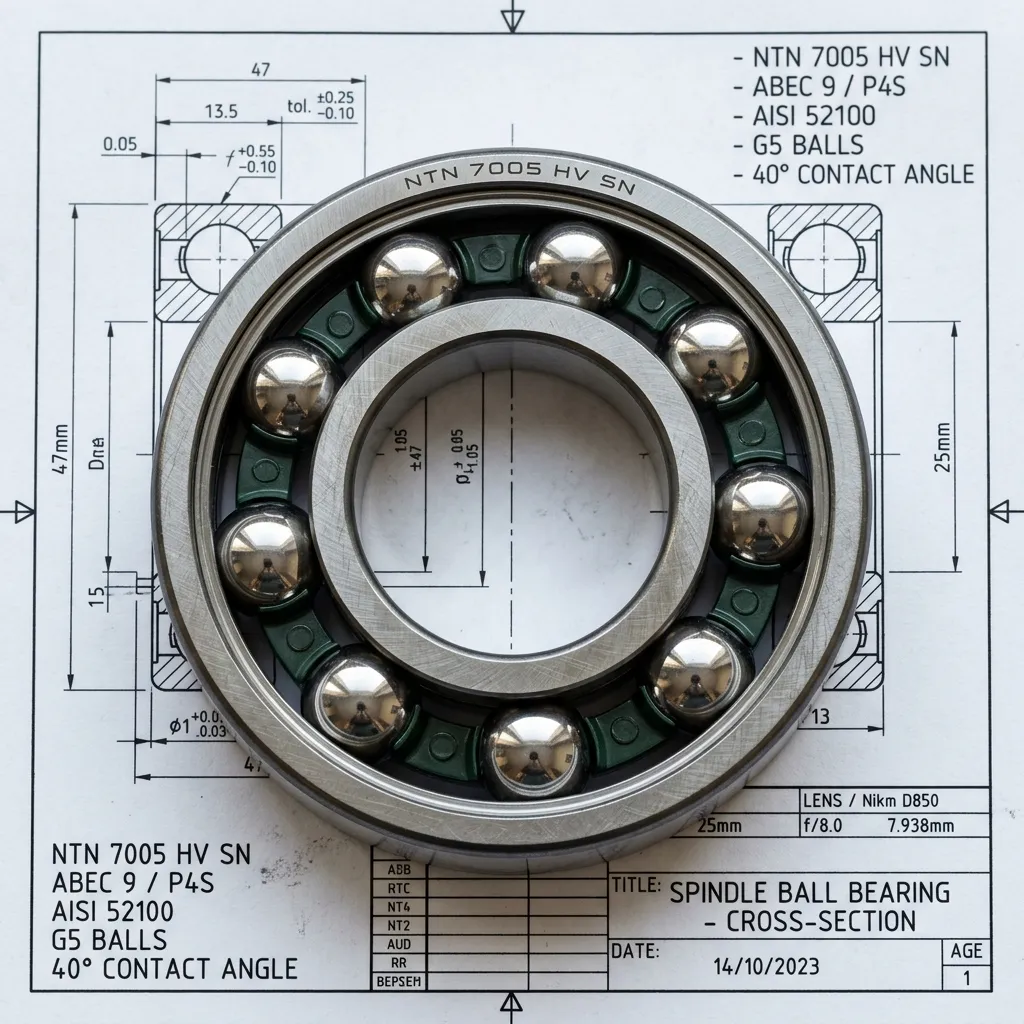
A ball bearing looks simple: a set of steel spheres rolling between two rings. But in high-speed applications—like aerospace turbines, CNC spindles, or electric vehicle motors spinning at 20,000 RPM—the physical demands placed on those spheres are extraordinary.
What is Sphericity?
Sphericity (or roundness) measures how perfectly a ball conforms to a true geometric sphere. In the bearing industry, this is measured in grades (e.g., Grade 10, Grade 25), indicating the maximum allowable deviation from a perfect sphere in millionths of an inch or microns.
The Consequences of Poor Sphericity
If a steel ball is slightly out-of-round (e.g., egg-shaped or lobed) by even a few microns, it acts like a microscopic speed bump inside the raceway.
- Vibration and Noise: At high RPMs, these "speed bumps" cause high-frequency vibrations, leading to loud, rough operation and transmitting destructive harmonics through the machinery.
- Friction and Heat: Out-of-round balls do not roll smoothly; they skid and drag. This friction generates massive amounts of heat, rapidly breaking down the lubrication and causing the metal to expand and seize.
- Point Loading: A perfectly round ball distributes weight evenly. An out-of-round ball concentrates extreme stress on specific points, leading to microscopic cracking, spalling, and catastrophic bearing failure.
At Rama & Sons, we manufacture premium EN-31 and AISI-52100 bearing steel balls using advanced lapping techniques to achieve exceptional sphericity for the most demanding high-speed applications.